lessons

So you want to play solos?

By | Guitar | No Comments

So you want to play solos? Where do you start? What skills do you need to have? What do you need to know? How do I look cool doing it?

This is one of the most common questions that I am asked in lessons and the best answer is the good old tried and true K.I.S.S principle. understand what is needed and play it. Easy right? Not always but we will look at a few things that will help you on your way to playing great solos.

Now people always say you need to be at an advanced level to play solos. This is not true obviously if you are at an advanced level then you will be capable of playing a more difficult solo but this is no indication of weather the solo is good or not. The best example of this is “Mary had a little Lamb”. Four notes played at a steady pace without a lot of fanfare. Now this piece would only present a challenge to a very small group of people but most people would be able to play it fairly easily and quickly. Now the thing about this tune is it is memorable, sounds pleasing to the ear, and is recognisable. This is a great example of a solo.

First things first. We need a basic understanding of how chords sound with the notes we play. If you play one note over particular chord it may sound great but if you play another note it could end up sounding really bad. The reason why is that some notes just don’t sound good together. How do I know what notes will work over what chords? Now we could get a friend to play a bunch of chords while you check and see what notes will work. Or an easier way would be to learn some scales and know what keys you can play them over.

Now before we jump in and learn a whole bunch of scales we need to understand what a key is. The best way to describe a key is to look at it like it is a bunch of notes that sound good together. This means that if we are playing the notes from a key and the chords that we are playing over are from the same key then theoretically this should sound good.

So what keys should we learn first? Well the best type of scale to start with is the Pentatonic scale. The reason why is because it only has five notes in it. So on any Instrument it is fairly easy to learn where five notes are on any instruments. I like to teach people three scale shapes and how they link together.

These shapes need to be learned so well that regardless of what note you are fretting you will be able to see how they link to the other two scales. You need to be comfortable linking them moving up the neck (towards the bridge) as well as moving down the neck (towards the headstock).

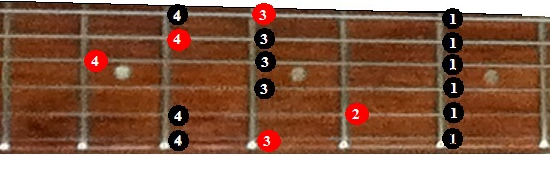
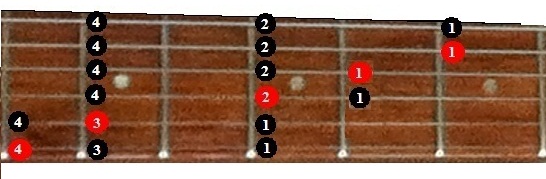
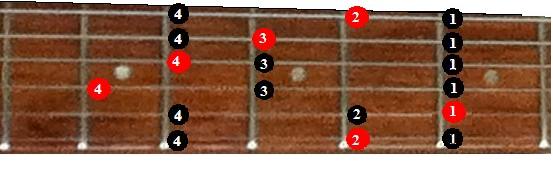
The scale shapes used here have two different colours marked on each shape. At first we will be focusing on the ones in black. These notes are the notes that most easily fit over the chords we will be using. Once you are comfortable using the black notes you can start to incorporate the red ones.

The numberings refer to which fingers should be used to fret the notes. For ease of reference, you should imagine that the guitar headstock is to the right-hand-side of the page and the first (high E) string is at the bottom of the diagrams.

These shapes are moveable and can be played anywhere on the fretboard. For best results, try to play them in as many positions as possible. Remember, the more thoroughly you learn these shapes, the easier it will be to use them in solos.

The first thing we need to do is learn the scale shapes and how they are linked. These shapes need to be learned so well that regardless of what note you are fretting you will be able to see how they link to the other two scales. You need to be comfortable linking them moving up the neck (towards the bridge) as well as moving down the neck (towards the headstock).

1. Minor shape one: The second note of this scale is the same as the first note of the next scale
2. Major shape: The third note of this scale is the same as the first note of the next scale
3. Minor shape two: The second note of this scale is one tone (two frets) from the first note of the fist scale. If the second note of this scale is on the 7th fret then the first note of the first scale will be on the 9th fret.
Now that you are familiar with the shapes and how they are linked, you need to find some note groupings that you like. A good solo is recognisable – you can hum along to it and most of the more memorable licks are very simple. Try to focus on a single idea with only four or five notes and then use the techniques mentioned earlier in this book to enhance them. You can also add other notes from the scale shapes to give it some variety. The more you do this the better you will get.

The key to playing good solos and creating great licks is to focus on the melody or tune you are trying to play. The stronger this is, the better your solos will be. Always hear the tune in your head and then try to replicate it on your guitar. If you can do this then you will be well on your way to playing guitar solos.

And this is just the beginning. Once you are fluent using the black and red notes while playing along with the CDs, experiment with using other notes outside the scale shapes to see how they sound. There are 12 notes that can be used in music – so why limit yourself to just five or seven?!

www.12strings.com.au

www.12strings.com.au/piano-lessons

www.12strings.com.au/guitar-lessons

www.12strings.com.au/bass-lessons

www.12strings.com.au/ukulele-lessons

How do I get better fast?

By | Bass Guitar, Guitar, Piano, Ukulele | No Comments

This is the number one question that I am asked. And the best way to answer it is to say ‘by practising’. This is a topic that I have spoken about in the past (see ‘Practise Makes Marginally Better’), but this time I want to look at it from the perspective of the beginner who is impatient or unwilling to put the work in to get results.

We have all either been this person, or have seen this person complaining about their current level of ability. Or we have had to teach this person how to play an instrument. To turn these people around and get them improving quickly we need to understand why they are not getting results. Once we understand this then we can remedy the situation.

All of us who have practised and become better know the value of hard work and perseverance. For a person that has never had to do this before it can be a daunting task. Also people want to believe that you can sit and dream about playing well and it will happen. Unfortunately this is rare and for the vast majority it is unrealistic. Once we are able to accept that some form of practice is required then we are ready to take the next step.

To help a person see the benefit in practising you need to make them aware of the results. Now the easiest way to do this is to let them see the improvement. As we all know, with some things it can take a while to see the actual results of practice. This will cause a lot of people to think that their hard work is fruitless and that they are not making any progress. But if they practice the correct movements and concentrate on keeping their movements efficient and relaxed then results will appear a lot faster.

In my experience I have seen both extremes of this type of behaviour. I have noticed that the students who improve the fastest and see results the quickest are the ones who focus on gaining control over the correct movements. They also make sure that they perform them extremely slowly until their muscles become familiar with the movements and they have developed control over them. On the other side of the ledger are the people who think that running through chord changes and difficult single note passages without any focus on control or efficient movement will get results. It is sad to say that this is not always the case – yes you will improve but not as fast as somebody who has worked on efficient movement and technique first.

Beginners are not the only people guilty of this type of behaviour. Many more experienced musicians can fall into this trap when learning new techniques or styles. What we all need to do is come up with a plan or template to help us on our way. The first and most important thing to do is ask ourselves ‘is this the most efficient way to perform this technique?’

Now before you rush in to saying yes or no you need to be aware of a few things. Are the fingers moving in the most efficient way (i.e. are they only moving enough to perform the technique without any excess movement)? Are the correct muscles or body parts performing in the correct manner? Are all other parts of the body that are not required kept in a relaxed state? If you have answered yes then you are on the right track.

Check back soon for the next part of this article.

www.12strings.com.au

www.12strings.com.au/piano-lessons

www.12strings.com.au/guitar-lessons

www.12strings.com.au/bass-lessons

www.12strings.com.au/ukulele-lessons

Why do you want to play the piano? 2

By | Piano | No Comments

Now, if you wanted something to use in a band situation then a grand piano is out of the question and so is a upright for the simple reason that these pianos cannot be transported easily. so you would start of looking at an electronic piano or keyboard. Now if you require the piano to make a lot of different instrument sounds then you will need something capable of producing these sounds but things like keyboard width and weighted keys are optional. The same type of instrument is suitable for a person that is looking to compose complex pieces but is not applicable to some body trying to program notes in to a computer. For this task all that is needed is a small keyboard that is compatable with the computer you are using.

Now the last and what will be the most important factor is the price. Now if price wasn’t an issue we would have the best sounding coolest looking and most hi tech instrument available sitting in the piano room of our mansion but unfourtunatley for most of us we don’t have this choice. So how do we get all of the features we want at the price we want? Now there are a lot of pianos and keyboards available and depending what you need them for you can spend under one hundred or could spend in to the tens of thousands. Buying pianos or keyboards especially well known brands new can be expensive but if you want some thing that has a decent warranty and a proven track record then this is the way to go. If you are willing to look at other makes then you might be able to get some thing that fits the bill at a reduced rate because the brand name is not that well known. The only way to know if you are buying a dud or a hidden treasure is to do some research.

Now to do that look at the specs for the piano are they right for you? Will they do the job? Is it a practical instrument for you? If so then how do you know that it will do the job you need it to do. Try it out that will be the easiest way to tell if the piano does what you need it to do and most good piano/keyboard outlets will let you spend time making sure that you are making the best choice. Ask questions. If it is a piano. How much does it weigh? Will the removalist be able to get it in to my house? if it is a keyboard. How are the keys weighted? as older or lesser quality electronic pianos have springs to create the feeling of weight but the higher quality and newer instruments have a mechanism that feel very close to an acoustic piano. Do you have any reviews? Does it come with a warranty? You can also look at some of the reputable review sites or forums online these are usually real people who have tried these instruments. Ask your piano teacher if they are familiar with the brand. If you are looking in to playing in a band ask other musicians. Is it hard to transport? Is it reliable? What is the sound quality like? If you are going to use it to input music into a computer. Will it be compatable with my computer? Will I need more software? Will I need to buy any accessories? If you are satisfied with the way the instrument sounds and it does what you need it to do and you are happy with the answers for the questions and research you have done then this may be the piano for you.

The next option is second hand now choosing a piano or keyboard this way can be fraught with danger as every one has heard those stories if people getting lumped with a lemon. Now this is where experience will be invaluable. If you know some one who has experience with pianos like a piano tuner or keyboard sales person or piano teacher then try and get them to help they can advise you weather the instrument you are looking at will be right for you. They can also tell you what a fair price would be for the instrument. When buying pianos second hand you need to know things like how long ago was the piano tuned? Because the longer a piano has stayed untuned the more likely it will be that it may not be able to be tuned to concert pitch. Try all of the keys and pedals to make sure they are in working order this applies to electronic keyboards as well. If there is some thing wrong find out if it will cost you to fix it and how much it will cost. Have a look and make sure that the piano is in good shape structurally as this may cause problems as well. Use common sense pay when you pick the instrument up. Check that all things are working the day you pick it up. If you are buying a keyboard to use with your computer make sure it will work with the computer you have.Now buying second hand can knock $150 -$300 off the price of an instrument so this can be a really good way to get an instrument cheaper but you will miss out on warranties and garantees. if you use common sense and do your research it should make this process run a lot smoother. If you are buying make sure you factor in the cost of removals and tuning as this may make a great price seem expensive really fast.

Remember why you want to play the piano? And what your goals are? And what kind of piano is right for you. Does the piano/keyboard do all of the things you need it to do. Will it fit in to the space it will be positioned. If you are using it for a band is it portable? Does it have the audio capabilites required? Is it the right price? If the instrument does all of these things then it could be the instrument for you.

www.12strings.com.au

www.12strings.com.au/piano-lessons

www.12strings.com.au/guitar-lessons

www.12strings.com.au/bass-lessons

www.12strings.com.au/ukulele-lessons

The Bass Guitar: So Underrated! 2

By | Bass Guitar | No Comments

Rhythm

Now that we have a very basic understanding of how your note selection contributes to your bass part, let’s look at what the rhythm can do to a bass line when you play. The rhythm of the piece has nothing to do with you – this is decided by the piece itself and what the drummer/percussionist is doing.

As a bass player you need to provide the link between the rhythm, the melody and the harmony. You can still play the notes that will improve the song but you will need to play them when the drums or percussion are hitting. This will tie the rhythm in with the rest of the music.

If you look at a drum kit or percussion set you will notice that each element is a different size and they should be treated as though they are different notes. Using this approach, we could start to put together a bass rhythm that can highlight the low drum sounds by only playing when a lower drum is played and playing a low note to accentuate it. Alternatively, you could do the same thing with a higher sound.

You could also help reinforce a rhythmic pattern by playing the same rhythm beat-for-beat for a section or let the whole thing breathe by only playing every few beats. The thing you must remember is to tie all of the parts of the song together (rhythm, harmony and melody) – if you can manage this you are well on the way to being a good bass player.

Conclusion

Playing the bass guitar is sometimes looked down on but if you do it well, understand what you need to do and have the technical capability to execute it with the best interests of the song in mind, then you are well on the way to becoming a great bass player.

People often try to be flashy and say things like: “I would play a descending G minor scale over two octaves in that section”. And, while that might sound impressive, you should remember that you should only do this if it makes the song better. I have played some guitar-inspired speed licks at times but only if it enhances the melody and helps tie in the rhythm. Make this your motto: “Just because you can doesn’t mean you should”.

www.12strings.com.au

www.12strings.com.au/piano-lessons

www.12strings.com.au/guitar-lessons

www.12strings.com.au/bass-lessons

www.12strings.com.au/ukulele-lessons

The Bass Guitar: So Underrated!

By | Bass Guitar | No Comments

I have so many people ask me if the bass is easy to play because it only has four strings. The only way to answer this is to say yes – it is relatively easy to be able to play a simple bassline to most popular songs. But it’s much more difficult to understand what needs to be done to enhance the harmony of a piece and stay true to the rhythm, or to cover a chord progression or drum part or lay down a groove so powerful that people have no choice but to dance.

The reason that there is a huge gap between the good bass players in the world and the great bass players in the world is because of the lack of understanding that most musicians have about the job description of the bassist. If asked, the vast majority of musicians will say the job of the bass player is to hold down the bottom end or to play the root notes (the notes that the chord is named after, i.e. G major’s root is the G note) of a chord. While that definition is not entirely wrong, it is not completely right either. Yes, it is important to hold down the bottom end and playing the root note of a chord is a good way to do that but the main reason the bass is involved in a piece of music is to help support and harmonise the melody.

Now for some people this may come as a surprise but once you realise this then you will be open to a whole range of possibilities. The final piece of the puzzle is tying the rhythm and harmony together.

Note selection

So how do we approach playing a bassline? To put it simply, we need to choose notes that support and harmonise the melody and we need to play them in a way that mirrors the drum or percussion part. Easier said then done.

Now to find the notes that best support the melody, what are we looking for? The easiest notes to find are the root notes of the chords in the chord progression. We could also play the melody notes, which is useful when you want reiterate a point, but not so good if you do it so much that what ever point you are trying to make is lost because the audience has become bored with everyone playing the same thing.

Another idea is to use the other notes that are in the chords (not the root note), as these notes will harmonise the melody, so in some cases you can use this technique to imply a chord that is not being played or reinforce one that is.

More advanced players can play any note that makes the piece better. To understand this concept you have to understand what the note that you are adding to the equation is doing to that part of the song. If there are other notes being played on other instruments at the same time (which is very likely!), then you will be part of a chord, so you need to know what this note does to the chord. Does it make the chord sound dissonant? If so, then this will create a feeling of tension, which is good if that is what that particular section is trying to build. Or it could be a complete cock up if the section is trying to resolve tension created earlier.

What if the note you are adding makes your part seem like it is moving (becoming gradually lower or higher)? This will build interest in your part as people will be listening for where you are going next. This can be great in a flat spot but not so good when another part is the focal point.

You could use your part to join the chords in a more gradual manner (starting on a note from one chord and working your way to a note in the next chord). That way the changes seem more fluid so that it sounds laid back and smoother to the ear. You could make the melody seem higher or lower with your note choice by playing above (higher than) the melody or below (lower than) the melody. So be aware of what your note selection will do for your part and for the overall sound of the music you are performing, but make sure that what you are doing will enhance the melody and song.

Check back soon for the next part of this article – how to use rhythm in your bassline.

www.12strings.com.au

www.12strings.com.au/piano-lessons

www.12strings.com.au/guitar-lessons

www.12strings.com.au/bass-lessons

www.12strings.com.au/ukulele-lessons

Buying guitars

By | Guitar | No Comments

So, what kind of guitar do you buy when you first start out on what will hopefully be a lifelong love of guitar playing?

Well, I have seen so many students, colleagues, friends and family over the years attempt to learn the guitar with varying results and one of the most common reasons why someone will give up is because they feel like their hands just aren’t cut out to play the guitar.
Now on very rare occasions this is true but generally the person doesn’t realise that it is not them that is the problem – it is their instrument that is stopping them from becoming better. I have heard every excuse from ‘my hands just aren’t big enough’ (get a smaller guitar to learn on), to ‘my hands are too weak to hold down the strings’ (make sure the action is set properly) and the classic my fingers hurt when I play (try nylon strings if you have them. Or just harden up!).
The key to playing well is having control over your hands and more importantly over your fingers, and that control is easier to gain if you are playing a guitar that is the right size for you and if the strings are easy to fret. Once you have the correct technique and know how it feels when you are playing properly, then you can apply that to any guitar.
The students that learn the fastest and end up being the best players are the ones who do everything right from the start – and that includes buying the correct guitar to learn on.
If most of your practice time is spent twisting your hands and body trying to come to grips  with playing your instrument or if you are worried about how sore your fingers are then not a lot of effort or concentration will be going into becoming a better guitarist!
So let’s take a look at some of the points you should consider when buying your first guitar.

First things first…
All of this information is written so you will be able to understand it whether you are right or left handed, so I will refer to your hands as the plucking hand (the one that strikes the strings) and the fretting hand (the one that holds the strings down).

Now, the first thing we need to consider is something that is usually overlooked when making this decision – what kind of guitar will help me to master the skills that are required to become a good (or maybe great) guitarist?
Now I know what most people are thinking – the first thing that popped into their heads was ‘what guitar looks good with my leather jacket?’ or ‘what guitar does my favourite guitarist play?’ but the most important thing a soon-to-be guitar owner needs to ask themselves is ‘will this guitar get me to the skill level I need to be at to achieve my goals?’
If the guitar you want does not get you there – and it doesn’t matter how great it looks – you should put it on lay-by and not buy it until you are at a high enough level to play it properly.
Now there are some people who have natural ability and talent. These people could learn and excel on almost anything but most people out there need to make the right choice when selecting their instrument. So let’s take a look at what factors should be considered…

Size
Now, what guitar will help you get to the level you want to be at? Well there are a few things that your first guitar will need to be. The first thing is that it needs to be able to be played without discomfort. So it has to be the right size for you – not your 6’10” best friend and not the child-guitar-playing-genius you saw on Youtube.
When I say that the guitar has to be the right size for you, that means you need to be able to reach all areas of the guitar without having your arms bent at funny angles. If you’re in a comfortable position it will be a lot easier to learn the essential skills required to play.
If you have larger limbs or hands then a small guitar may be too cramped for you to fit all of your fingers on the fingerboard. There are a lot of different sizes of guitars available these days from a full-sized dreadnought acoustic steel string on the large side, to a half-sized nylon string classical guitar on the small side, so there really is a size for everyone. The only downside as far as the smaller guitars go is the sound quality (although there are some really good-sounding, albeit pricey, small guitars available nowadays) but if you are using a smaller guitar when you first start to play then, when you have developed your technique, you will be ready to apply that technique to a larger guitar.

Electric or acoustic?
Another thing that needs to be considered is whether you are going to play an acoustic or electric guitar. If you choose electric then you’ll most probably need a strap as the shape of most electrics makes it difficult to balance them on your legs. You will also need to make sure that the guitar isn’t so heavy that it puts pressure on your neck and shoulders. If so then it may not be the guitar for you.
Most steel string guitars (both electric and acoustic) have narrower necks as the strings are closer together. This can make it easier to play certain chords and perform more difficult stretches. However, this can be a negative for people who have really thick fingers or “dad hands”, as the fingers are so thick that they get in each others’ way on the fingerboard.
Electric guitars have thinner bodies (even more so than a nylon string acoustic) so this will make things easier for the right hand and you should be able to reach all the right parts easily. But the same problem exists if you fingerpick with thick fingers – your fingers will get in the way of each other on the plucking hand as well.
If you get an acoustic guitar, you will have to choose between steel and nylon strings. The downside for nylon strings is that the neck of the guitar tends to be wider, which can hinder your fretting hand when playing some chords. However, the thinner body will make it easier for your plucking hand to reach the strings comfortably.
The body of a full-size steel string guitar can be very large and sometimes it can be hard to use your plucking hand well on these guitars.

Strings
Nylon strings are easy on the fingers – this will allow your fingers to develop calluses without a lot of discomfort and this in turn will allow you to practise regularly. Because steel strings are more rigid they tend to be harder on the fingers, especially for beginners. I hear a lot of people get discouraged from buying a nylon string guitar, as once you are better many people will want to move on to playing a steel string guitar, but this is complete rubbish!
Yes, when you are used to certain guitar strings it will be a bit of a change but only a slight inconvenience – the biggest thing that you will have to face changing from nylon strings to steel will be how much smaller the neck of the guitar is and for most people this is a plus. Another thing to note is that most electric guitars have lighter gauge strings which means they are easier on the fingers than a steel string acoustic.

Action
The action – this is the name for the distance between the strings and the fretboard – needs to be low, as this means the fingers will not have to press too hard. This also helps to keep the notes in tune. A low action also promotes a relaxed fretting hand which in turn will allow the fingers of your fretting hand to move faster.

Frets
Make sure all the frets sound well without buzzing on any string, as that is a sign of a poor set-up. If you are buying a guitar secondhand then you might have to get someone to set it up correctly and this can be expensive. If you are buying it new make sure that the store you are buying it from will set it up before you take it home.

So what guitar should I buy?
This all depends on what size you are, how long your limbs are, how big your hands are and what your pain threshold is.
People with large hands can handle the width of a nylon string guitar whereas people with shorter limbs are better off with an electric or half sized nylon string. People with a low pain threshold should use nylon strings and those who are not bothered by the pain should use steel strings.
Buying your first guitar can be tricky, so talk to someone who knows guitars and preferably has some teaching experience, as this will provide a different perspective on what is good to learn on.
There are so many choices of guitar in a lot of different price ranges so don’t worry, there will be a guitar that will help you achieve your goals at the right price. All you need to do is be honest about your size and shape and limb size. You will start off on the right foot and progress much faster because you have the perfect guitar for you.

www.12strings.com.au

www.12strings.com.au/piano-lessons

www.12strings.com.au/guitar-lessons

www.12strings.com.au/bass-lessons

www.12strings.com.au/ukulele-lessons